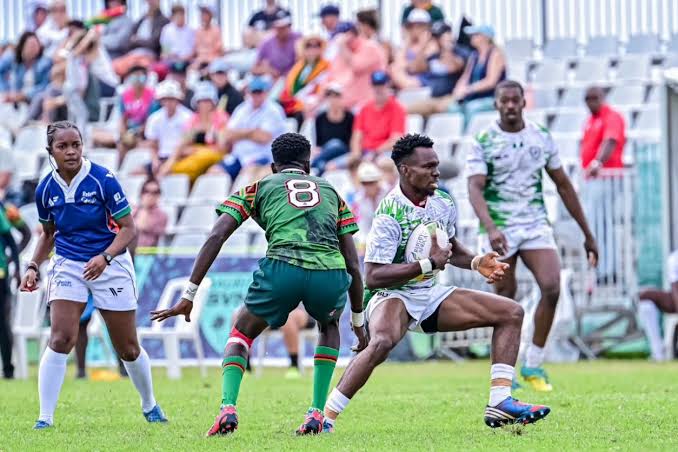
The Nigeria Rugby Football Federation (NRFF) has officially unveiled its comprehensive 2026 calendar of activities, outlining one of the most expansive domestic rugby structures in recent years and a renewed commitment to reposition women’s rugby on the continental stage.
The strategic roadmap emphasises grassroots expansion, youth development, high-performance pathways, and enhanced international competitiveness in both the 7s and 15s formats.
Expanded Domestic Competitions
The 2026 season will feature a broadened national competition framework designed to deepen participation and strengthen talent identification across the country.
Key highlights include:
- A National 7s Circuit (Men’s & Women’s) across host states such as Kano, Lagos, Delta, and Edo.
- A six-zone National 15s League (North, South West, South East, South South), culminating in national finals in Abuja.
- Youth-focused tournaments including Get Into Rugby 2.0 (U13 & U18) and Rugby 7s at the National Youth Games (U15).
- Community and school competitions such as the Golden 7s Schools Tournament and National Open 7s (U18).
- International exposure through the (Men’s) in Mauritius and other invitational fixtures.
According to the federation, the expanded structure is aimed at increasing match exposure, improving player development pipelines, and ensuring nationwide representation.
Women’s Rugby Back on the Continental Path
A major pillar of the 2026 agenda is the revitalisation of Nigeria’s women’s rugby programme.
The NRFF has submitted a bid to host the Africa Cup Women’s 7s Regional Qualifier in Lagos/Ogun. Securing hosting rights would restore Nigeria’s women’s team to continental rankings and provide a qualification pathway to the Africa Women’s Cup 7s.
In addition, the federation is exploring participation in Tunisia with a potential route toward qualification for Africa’s elite women’s rugby competition.
Officials say the dual 7s and 15s development strategy is designed to build a sustainable, competitive, and structurally sound women’s rugby programme.
Capacity Building and Governance
Beyond competitions, the 2026 calendar incorporates governance and technical development initiatives, including World Rugby-accredited training courses for coaches, medical personnel, match officials, and strength and conditioning professionals.
The federation also plans to implement anti-doping education programmes and structured school engagement initiatives to strengthen compliance, professionalism, and long-term growth.
International Outlook
Nigeria is set to compete in the (Men’s), pursue additional international test opportunities, and deepen regional collaboration through the West Africa Rugby Series under frameworks.
Describing the 2026 season as pivotal, the federation stated:
“Our domestic competitions are stronger, our women’s programme now has a clear continental pathway, and our youth initiatives continue to expand. We are building a sustainable rugby ecosystem for Nigeria’s future.”
The NRFF maintains that the 2026 calendar represents a strategic blueprint for performance growth, women’s empowerment, and Nigeria’s sustained resurgence within African rugby.